Land Reform: China and North Vietnam
China and Vietnam have gone through many changes over their lifetime. They have had dominant people in power that control what goes on in terms of the amount of land China and Northern Vietnam have gained or lost from their enemies. One major problem that still goes on to this day is land reform. Land reform occurs when the government takes the land from the dominant land lords and redistributes the property that was rightfully owned by the land lords and generously donates it to another individual.
The time frame I looked at about the struggles and problems that land reform brought up, was from 1953 – 1957. This process has caused a great deal of troubles and solved few situations. It has made their main focus worse. This focus consists of the land owners overpowering near by land dwellers, almost establishing a personal work force and maintaining the bridge between the rich and the poor to become greater.
With the idea of land reform, it still, in the end, turns to be a slave-like atmosphere. When the government gives the land to these poor peasants to work this piece of property, some of them become overwhelmed which could, in turn, lead to a bad harvest season. In return, these poor peasant workers turn back to the powerful original land owners for help and take out loans. Now, the only way for these peasants to pay off these loans is by the land they are harvesting on and sacrificing their only way to make and establish some type of money for themselves. This is an on going situation that always ends up back at the idea of these peasants working for the dominant land owners.
Anther idea the government tried to push with land reform was reestablishing a new social system. This social system was the idea of bridging the large gap between the rich and the poor. With the distribution of land to the poorer portion of China and North Vietnam, the government felt it could bring positive outcomes back to its community, but even more importantly to its country. At first, these dominant land owners were against the idea because they felt they were losing more than they would gain from the twist on an agricultural distribution. The government reassured them they would not have anything to worry about; that this is a way of smothering the idea that even though these land lords had a great deal of power, with the new motion of dispersing land to everyone would accept the fact or idea of having someone in charge of them. Land Reform had many alterations going on at the same time. It was dealing with the war between the French and ending their rule among the North Vietnamese. While the French was being pushed out the land reform made things even harder. Here we have a society trying to fight off a world leading population to set in stone a new era. They are trying to stick with the motto “out with the old and in with the new”, if the government would have only realized the can of worms they would open with this idea they took from Russia.
It was Russia who rightfully had the first idea or notion of creating a land reform society. It was the idea that if it worked for them maybe it could work for us. This idea brought on a couple other problems the people of North Viet Nam and China faced. They were introduced to a society of where taxation was about to take over. This is another problem why land reform failed the peasants who just received this land had to pay a tax which if a bad harvest came the idea of turning back to the land lords for financial aid was the best thing.
Land Reform in China and North Vietnam, Edwin E. Moise
This book was very intriguing it gave the reader an in depth look on a society that was suffering on so many different levels and the government of these people tried to help but in the long run they ended up hurting the people of these countries more that they could have possibly helped. It was sad because these people were like puppets and the different government types were using them as toys to push their type of governing tactics. The book specifically discussed three different tactics they would use to enforce their reforms. The first one was having the new ruler simply take over where the old one left off. This left the Vietnamese with very little fundamental changes on society and their lifestyles. The second was the “Nationalist”. This is when they would “assert themselves against foreign powers”. (Moise 3) They also felt pushing a modernization and economic development would be in their favor. The third tactic involved a rebellion of the poor to overthrow the basic structure of society and favor an egalitarian order. These structures of government were pushed through this time period and each was trial tested and failed at extreme costs of society. This not only hurt the patrons of the country but the country itself as a whole.
The idea to start this out came from Russia. There was an idea of dividing the land is the central element and returning this land to it original owners. It was not an easy idea for the original land owners to swallow. They felt this idea was mainly directed at them, that the old and elite names of the society would lose their power if the government gave their land away to the peasants.
With the idea of land reform, many main points came up; one being that an unnatural outgrowth of village life was happening. With this, it caused a great deal of poverty, making people poor due to a lack venturing out to further better themselves. Participation by local peasants had to be genuine, understanding the rationale of those policies well enough to apply them. These policies put a great deal of burden on the peasants and the land lords. The peasants did not know how to act or what should be done with the idea of government taking one thing from a powerful individual and giving it to a poor peasant. With this going on, the land lords had to express interests in the peasant life. They were not allowed to deceive or look down on them but be heartfelt with their thoughts. This again was hard because it was such a harsh and dramatic change in the usual lifestyle they were used to.
Sources:
“Forum: Memories of Land Reform; To Hoai’s Three Others”, Journal of Vietnamese Studies, Summer 2007, Vol. 2, No. 2
This author of Memories of Land Reform: To Hoai’s: Three Others touches on a lot of resources that are extremely relative to what is mentioned in the Land Reform of China and North Vietnam. It mentions that “the Land Reform had gone terribly awry” that the government finally admitted to that. It is sad to say but this is a part of history that could have been heavily avoided if the idea behind it would be researched and had an outlook on it. All they did, it was said, that the idea of a land reform came from Russia. It is nice to see that with this the government arranged a “Rectification of Errors” where they came together and talked about all the mishaps that had happened. In later meeting the senior leaders in charge were stripped of there roles and replaced immediately. Ho Chi Minh was put in charge and started taking the appropriate steps in evaluating what was necessary and should have happened. Great deals of peasants were released from jail for being wrongly accused of their actions or beliefs on the matter.
Another book that involves Ho Chi Minh a great ruler that was in office for a short time but is heavily noted for his accomplishments and is noted again in a novel called Revolution in the Village, that gives his views on the idea of what Vietnam should be, which is a country where everyone is a equal person. It was noted when Ho Chi Minh gave his famous speech in 1945 about how everyone has the right to keep their right of independence and sacrifice their life when the time was needed and to stand up because they earned their respect and rights by fighting off power house forces such as Japan and France. I feel this action should have waited when the land reform was going on, then people would have stood up and united and realized what was going on in there own country and make smarter moves in perfecting the society they live in. The changes made during the land reform were childish, wrongly provoked, and in the long run hurtful to North Vietnam. Many people lost their lives during the government times of “testing” out new tactics which they thought would work for their civilization. It was at this time when their country felt as if they were whole. They realized what was going on and what had been happening, it was one individual who voiced what he saw and had others agree with the mishaps that were corrupting the country they lived in.
Land Reform was an idea that survived its time but not its purpose. The initial intention behind the fact of trying to bridge the gap between the rich and the poor was a heart warming idea, but would never stand in the civilization these peasants and land lords lived in. It was a reoccurring cycle that just stretched out time for the communities to get back to right where they started.
Revolution in the Village, Hy Van Luong
This book I used to better understand a life of an individual living between the time frame of 1954 - 1987 I mainly focused on the years that corresponded with my book. It touched on many sensitive subjects and uncomfortable situations they took on in their life time. It went on to explain when villages were test subject from the government at first the elderly people were against what was going on. Then when it caught negative attention from the whole village and they realized it was hurting them more than helping them, the idea was run out of the village.
David G. Marr, Review, The Business History Review, Vol. 59, No. 2 (summer, 1985), pp. 343-345
I viewed David G. Marrs review to obtain a better understanding of the time period and the situation at hand that is going on. From a student’s perspective to Professor Marr his background on the subject cleared a lot of confusion with me as far as the relationship between North Viet Nam and China. It was also nice to see another person’s opinion on the book. I feel he is a little harsh on the idea of Moise not having direct sources for his book. He brings up the fact that if the government did not have any clue what was going on and how things should be solved then how could Moise. I feel that Moise gave clear cut pieces of information to back up the experiences and the situations that were going on in North Vietnam and in China. Another topic of why land reform was given a test trial Marr try’s to say is to “increase the agricultural production”(Marr, 344). The idea and I think it stands for itself was to build a bridge between the gap of peasants and rich, not the agricultural problem. I can understand that it might have been slow, but that was due to poor harvests or slack on the land owner’s part for not farming correctly. The land was going to be there and producing its crops whether one person ran the land or it was spilt and the land was distributed.
Friday, June 13, 2008

The National Liberation Front
Context:
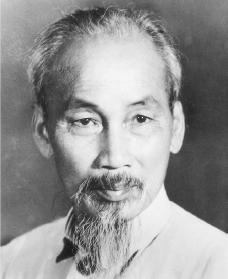 Ho Chi Minh
The formation of the National Liberation Front in 1960 was the brainchild of Lao Dong, Vietnam’s Communist Party based in Hanoi. American troops came to call the NLF the Viet Cong, VC, or Charlie simply to demean them. Lao Dong officials commonly referred to as Hanoi by Americans who linked every move of the front to the communist Capitol, recognized the necessity of carrying out both a political and military struggle to achieve their ultimate goal of crushing the illegitimate Saigon regime. The front was therefore the political wing of the communists operating below the 17th parallel. The Communist’s first attempt to liberate the south failed following six years of solely political actions. Hanoi thus created the military faction of the front, the Peoples Liberation Armed Forces (PLAF). Hanoi implemented the front technique in past conflicts with Japanese and French Imperialists with success. Communist front predecessors to the VC included: the Viet Minh, the Lien Viet, and the Fatherland Front. The front made several pivotal contributions for the eventual communist victory. The largest three contributions being: Negotiating with the U.S., Propaganda, and Foreign Relations.
There are several disputable events, decisions, and relationships regarding the National Liberation Front and its role in the Second Indo-China War or the Vietnam War, in the West. For example, was the NLF under direct control of Hanoi as U.S. administrations advertised? While it seems the Lao Dong viewed the NLF as their chief source of propaganda and comrades in the South. The U.S. repeatedly attempted to link the NLF to the communists in Hanoi. Several high-ranking NLF officials were indeed communists, some were not. Most experts in this area concur that a relationship directly linked the front to Northern communists, but not nearly at the level Americans like Dean Rusk and President Johnson assumed. One significant piece of evidence supports the thought of the front operating without complete Northern communist oversight. The fact being that Lao Dong and the NLF waged separate diplomatic offensives internationally. Specifically in July of 1964 amidst Political chaos in Saigon with the constant fear of another coup de tat, Lao Dong officials successfully whined and dined United Nations’ secretary general U Thant and French president Charles de Gaulle. Both Thant and de Gaulle agreed that diplomatic negotiations were the only way to end an escalating military conflict and suggested the reconvening of the Geneva Conference. Later the same month, the NLF’s president, Nguyen Huu Tho announced the front’s readiness for peaceful negotiations, Tho gained the support of: Peking, Moscow, and Hanoi prior to reading the declaration. A second debatable idea regarding the NLF involves a shift in party policy.
Shortly following its inception the National Liberation Front adopted a Neutralist platform, which in this juncture in history referred to nonalignment in the cold war. Many developing Asian and African nations adopted a similar policy. By far the most crucial Neutralist nation was the communists’ former nemesis, France. The NLF’s unbiased policy helped them achieve three important goals. These achievements were: distancing the front from Hanoi, forging international ties with nations and leaders abroad, and defacing the Saigon Regime.
Another communist action littered with question marks is the NLF’s reason for abandoning its neutralist policy. As early as 1963 following the coup which led to the overthrow and death of Ngo Dinh Diem, certain Lao Dong officials in the form of the Central Committee began questioning the front’s neutrality as to weak and Western. The Central Committee was essentially the cabinet of the Lao Dong, and its secretary general was Le Duan. Le Duan still strongly supported the idea of a neutral policy for the NLF. Duan could see the confusion and frustration it was causing Washington. While members of the Central Committee continued to call for an end to neutrality the policy wasn’t officially abandoned until 1965 when Lyndon Johnson ordered the start of bombing raids with Operation Rolling Thunder and the presence of U.S. ground troops for the first time in Vietnam.
Le Duan
Robert K. Brigham’s Guerilla Diplomacy: The NLF’s Foreign Relations and the Viet Nam War is an enlightening account of both military and diplomatic strategies implemented against the Saigon regimes and Americans in South Vietnam.
Brigham’s focal point is the examination of “the development and implementation of the NLF’s international strategy and assess its impact on the war”. Another key point Brigham addresses but does not come to a definitive answer on is the level of control Hanoi had over their southern liaisons, the NLF. Guerilla Diplomacy provides an intensely non-ethnocentric view of the Second Indo-China War. Brigham draws his research and evidence from mainly communist documents from Hanoi as well as some personal interviews. Brigham delves into specific NLF strategies such as Neutrality, a twin goal policy to introduce socialism in the North and to liberate the South, all while fighting and negotiating simultaneously.
The book opens with Lao Dong officials in Hanoi who strongly believe Vietnam was heavily shorted at the negotiation tables of the Geneva Conference. The reestablishment of the Diem regime revealed to the Lao Dong what they must accomplish. The Lao Dong congregated in 1960 forging the National Front for the Liberation of Vietnam, after the hated, Catholic Ngo Dinh Diem had regained his power in the South. Knowing the NLF would be under close watch by the French and United States they quickly decided to adopt a policy of neutrality. The adoption of this policy was the first of many that would aid Hanoi in discrediting and wearing down imperialism in Vietnam. Propaganda was also an incredibly useful tool the Front would utilize repeatedly.
When Washington decided direct American military intervention provided the best chance for victory in 1965, Operation Rolling Thunder and the addition of U.S. ground troops were the result. The front saw an opportunity to abandon their neutralist policy in favor of an anti-American one. This policy existed in twin goals: the development of Socialism at home, and the liberation of Southern Vietnam. Brigham also goes in depth addressing the success of the NLF’s implementation of foreign policy. Hanoi realized that making the Americans look bad in the media and to other world leaders was almost as important as defeating them on the battlefield. NLF leaders toured friendly countries separately from Lao Dong officials in an attempt to distance the Front from the Communists in Hanoi.
Brigham successfully illustrates the hoops that Hanoi and the NLF forced the administrations of: Kennedy, Johnson, Nixon, and Ford to jump through. After the fall of Saigon it was clear that the Communists in the North and the NLF in the South had clearly, implemented far superior strategy and diplomacy to that of the Americans.
Subtexts:
 Le Duc Tho
1. Fitzgerald, Frances (2002). Fire in the Lake: The Vietnamese and the Americans in Vietnam. Boston: Little, Brown and Company.
This popular text by Fitzgerald highlights several paradoxes that arise due to American involvement in Vietnam. Rural farming villages and crowded cities, Catholics and Buddhists, soldiers and monks, and especially Communists and non-communists are the main contrasts Fire in the Lake deals with. This novel explores the specific reasons of how and why American misinterpreted the people and nation of Vietnam.
2. Rotter, Andrew J. Light at the End of the Tunnel: A Vietnam War Anthology. New York: St. Martin’s Press, 1991.
Rotter’s account focuses almost entirely on U.S. experiences during the war. Rotter clearly identifies differences in American and Vietnamese culture as well as methods of the communists. The book is broken down into three sections. The first of which deals with American involvement in the war chronologically. The second section depicts the war on the battlefield, guerilla tactics utilized by the VC early in the war and the formation of the NLF. The Third section of Light at the End of the Tunnel concentrates on reasons for U.S. involvement, including ideas such as the Domino Theory and decline of support at home.
3. George Katsiaficas. Vietnam Documents: American and Vietnamese Views of the War. Armonk, New York. M.E. Sharpe Inc., 1992.
Katsiaficas’ anthology differs from most of its kind in the fact that over a third of his resources include Vietnamese documents. Katsiaficas touches on key twists and turns of the Vietnam War. The Geneva Conference, the Gulf of Tonkin Resolution, and American build-up are three of the eight points he focuses on. Katsiaficas, a grizzled antiwar veteran refuses to shy away from those ideals throughout this collection. Excerpts from: Ho Chin Minh, Henry Kissinger, Nixon, and Lyndon Johnson are some of the creators of documents Katsiaficas includes.
4. Duiker, William (1996), The Communist Road to Power in Vietnam. Boulder, Colo.: Westview Press.
In The Communist Road to Power Duiker’s strongest argument arises when speaking about the North’s decision making processes and the adjustments and responses of the Communists to American policy. One major issue with this book is Duiker’s bias toward the communists. This bias has not as much to do with Duiker as it does with the material Duiker used for research. It is extremely difficult for any researcher that uses Communist documents as his or her main source of research due to the socialist bias inevitably contained in them. Duiker’s study focuses mainly on NLF strategy and tactics, both in diplomacy and military. Duiker however, neglects certain aspects of the NLF’s war such as propaganda.
5. Truong Nhu Tang, A Viet Cong Memoir. Assisted by David Chanoff and Doan Van Toai.
New York: Haracourt, Brace, Jovanovich. 1985. Pp. xiv, 350.
Tang’s A Viet Cong Memoir focuses around the author’s own experiences as both an executive of a Southern Vietnamese sugar corporation and an active member of the revolutionary government. Tang rose to the position of Minister of Justice in the newly founded Provisional Revolutionary Government in 1969. Tang’s story does not end with the fall of Saigon as Guerilla Diplomacy does. After the Communist takeover and American withdrawal the PRG was dismantled and replaced with the Saigon Military Management Committee, which was comprised of all Northern Communists. Hanoi and the NLF had made friendly with southern non-communists during the war and essentially abandoned amidst the formation of a self-determined Vietnam.
Wednesday, June 4, 2008
Land Reform in China and North Vietnam
Ben Banasiak
Hist 334
Rough Draft #1
Vietnam has gone through many changes over its lifetime. It has had dominant people in power that control what goes on in terms of the amount of land Vietnam has gained or lost from its enemies. One major problem that still goes on to this day is land reform. Land reform occurs when the government takes it into there own hands and redistributes property that was rightfully owned by one person and gives it to another individual. The time frame I looked at about the struggles and problems land reform brought up was from 1953 – 1957 . This process has caused a great deal of troubles and solved few situations. It has made their main focus worse. This focus consists of the land owners overpowering near by land dwellers, almost establishing a personal work force and maintaining the bridge between the rich and the poor to become greater. With the idea of land reform, it still, in the end, turns to be a slave like atmosphere. When the government gives the land to these poor peasants to work this piece of property, some of them become overwhelmed which could, in turn, lead to a bad harvest season. In return, these poor peasant workers turn back to the powerful original land owners for help and take out loans. Now, the only way for these peasants to pay off these loans is by the land they are harvesting on and sacrificing their only way to make and establish some type of money for themselves. This is an on going situation that always ends up back at the idea of these peasants working for the dominant land owners.
Anther idea the government tried to push with land reform was reestablishing a new social system. This social system was the idea of bridging the large gap between the rich and the poor. With the distribution of land to the poorer portion of Vietnam, the government felt it could bring positive outcomes back to its community, but even more importantly to its country. At first, these dominant land owners were against the idea because they felt they were losing more than they would gain from the twist on a agricultural distribution. The government reassured them they would not have anything to worry about; that this is a way of smothering the idea that even though these land lords had a great deal of power, with the new motion of dispersing land to everyone would accept the fact or idea of having someone in charge of them.
The novel I read, Land Reform in China and North Vietnam, was a very intriguing book that gives the reader an in depth look on a society that was suffering on so many different levels and the government of these people tried to help but in the long run they ended up hurting the people of these countries more that they could have possibly helped. It was sad because these people were like puppets and the different government types were using them as toys to push their type of governing tactics. The book specifically discussed three different tactics they would use to enforce their reforms. The first one was having the new ruler simply take over where the old one left off. This left the Vietnamese with very little fundamental changes on society and their lifestyles. The second was the “Nationalist”. This is when they would “assert themselves against foreign powers”.(Moise 3) They also felt pushing a modernization and economic development would be in their favor. The third tactic involved a rebellion of the poor to overthrow the basic structure of society and favor a egalitarian order. These structures of government were pushed through this time period and each was trial tested and failed at extreme costs of society. This not only hurt the patrons of the country but the country itself as a whole.
The idea to start this out came from Russia. There was an idea of dividing the land is the central element and returning this land to it original owners. It was not an easy idea for the original land owners to swallow. They felt this idea was mainly directed at them, that the old and elite names of the society would loose their power if the government gave their land away to the peasants.
With the idea of land reform, many main points came up; one being that an unnatural outgrowth of village life was happening. With this, it caused a great deal of poverty, making people poor due to a lack venturing out to further better themselves. Participation by local peasants had to be genuine, understanding the rationale of those policies well enough to apply them. These policies put a great deal of burden on the peasants and the land lords. The peasants did not know how to act or what should be done with the idea of government taking one thing from a powerful individual and giving it to a poor peasant. With this going on, the land lords had to express interests in the peasant life. They were not allowed to deceive or look down on them but be heartfelt with their thoughts. This again was hard because it was such a harsh and dramatic change in the usual lifestyle they were used to.
This author of Memories of Land Reform: To Hoai’s: Three Others touches on a lot of resources that are extremely relative to what is mentioned in the Land Reform of China and North Vietnam. It mentions that “the Land Reform had gone terribly awry” that the government finally admitted to that. It is sad to say but this is a part of history that could have been heavily avoided if the idea behind it would be researched and had an outlook on it. All they did, it was said, that the idea of a land reform came from Russia. It is nice to see that with this the government arranged a “Rectification of Errors” where they came together and talked about all the mishaps that had happened. In later meeting the senior leaders in charge were stripped of there roles and replaced immediately. Ho Chi Minh was put in charge and started taking the appropriate steps in evaluating what was necessary and should have happened. A great deal of peasants were released from jail for being wrongly accused of their actions or beliefs on the matter.
Another book that involves Ho Chi Minh a great ruler that was in office for a short time but is heavily noted for his accomplishments and is noted again in a novel called Revolution in the Village, that gives his views on the idea of what Vietnam should be, which is a country where everyone is a equal person. It was noted when Ho Chi Minh gave his famous speech in 1945 about how everyone has the right to keep their right of independence and sacrifice their life when the time was needed and to stand up because they earned their respect and rights by fighting off power house forces such as Japan and France. I feel this action should have waited when the land reform was going on, then people would have stood up and united and realized what was going on in there own country and make smarter moves in perfecting the society they live in. The changes made during the land reform were childish, wrongly provoked, and in the long run hurtful to North Vietnam. Many people lost their lives during the government times of “testing” out new tactics whcih they thought would work for their civilization. It was at this time when their country felt as if they were whole. They realized what was going on and what had been happening, it was one individual who voiced what he saw and had others agree with the mishaps that were corrupting the country they lived in.
Land Reform was an idea that survived its time but not its purpose. The initial intention behind the fact of trying to bridge the gap between the rich and the poor was a heart warming idea, but would never stand in the civilization these peasants and land lords lived in. It was a reoccurring cycle that just stretched out time for the communities to get back to right where they started.
Hist 334
Rough Draft #1
Vietnam has gone through many changes over its lifetime. It has had dominant people in power that control what goes on in terms of the amount of land Vietnam has gained or lost from its enemies. One major problem that still goes on to this day is land reform. Land reform occurs when the government takes it into there own hands and redistributes property that was rightfully owned by one person and gives it to another individual. The time frame I looked at about the struggles and problems land reform brought up was from 1953 – 1957 . This process has caused a great deal of troubles and solved few situations. It has made their main focus worse. This focus consists of the land owners overpowering near by land dwellers, almost establishing a personal work force and maintaining the bridge between the rich and the poor to become greater. With the idea of land reform, it still, in the end, turns to be a slave like atmosphere. When the government gives the land to these poor peasants to work this piece of property, some of them become overwhelmed which could, in turn, lead to a bad harvest season. In return, these poor peasant workers turn back to the powerful original land owners for help and take out loans. Now, the only way for these peasants to pay off these loans is by the land they are harvesting on and sacrificing their only way to make and establish some type of money for themselves. This is an on going situation that always ends up back at the idea of these peasants working for the dominant land owners.
Anther idea the government tried to push with land reform was reestablishing a new social system. This social system was the idea of bridging the large gap between the rich and the poor. With the distribution of land to the poorer portion of Vietnam, the government felt it could bring positive outcomes back to its community, but even more importantly to its country. At first, these dominant land owners were against the idea because they felt they were losing more than they would gain from the twist on a agricultural distribution. The government reassured them they would not have anything to worry about; that this is a way of smothering the idea that even though these land lords had a great deal of power, with the new motion of dispersing land to everyone would accept the fact or idea of having someone in charge of them.
The novel I read, Land Reform in China and North Vietnam, was a very intriguing book that gives the reader an in depth look on a society that was suffering on so many different levels and the government of these people tried to help but in the long run they ended up hurting the people of these countries more that they could have possibly helped. It was sad because these people were like puppets and the different government types were using them as toys to push their type of governing tactics. The book specifically discussed three different tactics they would use to enforce their reforms. The first one was having the new ruler simply take over where the old one left off. This left the Vietnamese with very little fundamental changes on society and their lifestyles. The second was the “Nationalist”. This is when they would “assert themselves against foreign powers”.(Moise 3) They also felt pushing a modernization and economic development would be in their favor. The third tactic involved a rebellion of the poor to overthrow the basic structure of society and favor a egalitarian order. These structures of government were pushed through this time period and each was trial tested and failed at extreme costs of society. This not only hurt the patrons of the country but the country itself as a whole.
The idea to start this out came from Russia. There was an idea of dividing the land is the central element and returning this land to it original owners. It was not an easy idea for the original land owners to swallow. They felt this idea was mainly directed at them, that the old and elite names of the society would loose their power if the government gave their land away to the peasants.
With the idea of land reform, many main points came up; one being that an unnatural outgrowth of village life was happening. With this, it caused a great deal of poverty, making people poor due to a lack venturing out to further better themselves. Participation by local peasants had to be genuine, understanding the rationale of those policies well enough to apply them. These policies put a great deal of burden on the peasants and the land lords. The peasants did not know how to act or what should be done with the idea of government taking one thing from a powerful individual and giving it to a poor peasant. With this going on, the land lords had to express interests in the peasant life. They were not allowed to deceive or look down on them but be heartfelt with their thoughts. This again was hard because it was such a harsh and dramatic change in the usual lifestyle they were used to.
This author of Memories of Land Reform: To Hoai’s: Three Others touches on a lot of resources that are extremely relative to what is mentioned in the Land Reform of China and North Vietnam. It mentions that “the Land Reform had gone terribly awry” that the government finally admitted to that. It is sad to say but this is a part of history that could have been heavily avoided if the idea behind it would be researched and had an outlook on it. All they did, it was said, that the idea of a land reform came from Russia. It is nice to see that with this the government arranged a “Rectification of Errors” where they came together and talked about all the mishaps that had happened. In later meeting the senior leaders in charge were stripped of there roles and replaced immediately. Ho Chi Minh was put in charge and started taking the appropriate steps in evaluating what was necessary and should have happened. A great deal of peasants were released from jail for being wrongly accused of their actions or beliefs on the matter.
Another book that involves Ho Chi Minh a great ruler that was in office for a short time but is heavily noted for his accomplishments and is noted again in a novel called Revolution in the Village, that gives his views on the idea of what Vietnam should be, which is a country where everyone is a equal person. It was noted when Ho Chi Minh gave his famous speech in 1945 about how everyone has the right to keep their right of independence and sacrifice their life when the time was needed and to stand up because they earned their respect and rights by fighting off power house forces such as Japan and France. I feel this action should have waited when the land reform was going on, then people would have stood up and united and realized what was going on in there own country and make smarter moves in perfecting the society they live in. The changes made during the land reform were childish, wrongly provoked, and in the long run hurtful to North Vietnam. Many people lost their lives during the government times of “testing” out new tactics whcih they thought would work for their civilization. It was at this time when their country felt as if they were whole. They realized what was going on and what had been happening, it was one individual who voiced what he saw and had others agree with the mishaps that were corrupting the country they lived in.
Land Reform was an idea that survived its time but not its purpose. The initial intention behind the fact of trying to bridge the gap between the rich and the poor was a heart warming idea, but would never stand in the civilization these peasants and land lords lived in. It was a reoccurring cycle that just stretched out time for the communities to get back to right where they started.
Friday, May 16, 2008
Context: The National Liberation Front
There are several events, decisions, and relationships that may be disputed regarding the National Liberation Front and its role in the Second Indo-China War, one statement that is not would be that the NLF and its strategists were vital in the liberation of Southern Viet Nam and ousting of the Americans.
One part of this NLF story that is inconclusive and often debated is how influential were the communist leaders of the Lao Dong on the actions of the NLF. It is indisputable that the NLF was the brainchild of Lao Dong leaders in 1960. What does remain in question is exactly how much weight the Lao Dong pulled in NLF actions. While it seems the Lao Dong viewed the NLF as their chief source of Propaganda and comrades in the South. The U.S. repeatedly attempted to link the NLF to the communists in Hanoi. While several high ranking NLF officials were communists, many were not. Brigham walks a tightrope on this topic stating, “the Front was neither a puppet of Hanoi, nor an autonomous organization.”
Another topic up for debate could be the NLF’s reason for abandoning of its neutrality policy. Brigham credits northern communists for this change because the Lao Dong apparently felt that the NLF had gotten too western diplomatically. This could be due to his research with mainly communist documents. A counterpoint to Brigham’s argument could be formed regarding the massive 1965 American increase in troops and aid to the DRVN.
A third event that remains controversial is the relationship the Lao Dong and PRG had with Southern elites who supported the NLF. After the successful ousting of Diem and the capture of Saigon, a new government was quickly formed under military control. On the list of leaders which the communists released not one southern nor one non-communist appeared. This would seem to prove that Hanoi forged relationships with well-off southern communists and had no interest in including them in the ante-bellum regime. Experts believe these southerners were mainly excluded because they engaged in Capitalism and not because they hailed from below the 17th parallel.
Text: The National Liberation Front
Robert K. Brigham’s Guerilla Diplomacy: The NLF’s Foreign Relations and the Viet Nam War is an enlightening account of both military and diplomatic strategies implemented against the puppet regimes and Americans in South Vietnam.
Brigham’s focal point is the examination of ‘the development and implementation of the NLF’s international strategy and assess its impact on the war” Another key point Brigham addresses but doesn’t come to a definitive answer on is the level of control Hanoi had over their southern liaisons, the NLF. Guerilla Diplomacy provides an intensely non-ethnocentric view of the Second Indo-China War. Brigham draws his research and evidence from mainly communist documents from Hanoi as well as some personal interviews. Brigham delves into specific NLF strategies such as: Neutrality, a twin goal policy for socialism in the North and to liberate the South, and a strategy of fighting while negotiating later in the war.
The book opens with unhappy Lao Dong officials in Hanoi who vastly believed Vietnam was heavily shorted at the negotiation tables of the Geneva Conference. The reinstallment of the Diem regime revealed to the Lao Dong what must be done. The Lao Dong congregated in 1960 stirring with bitterness as the Catholic Diem had regained his power the Communists forged the National Front for the Liberation of Vietnam at this meeting. Knowing the NLF would be under close watch by the French and United States they quickly decided to adopt a policy of neutrality. The adoption of this policy was the first of many which would aid Hanoi in discrediting and wearing down imperialism in Vietnam. Propaganda was also an incredibly useful tool the Front would utilize repeatedly.
When the U.S. and L.B.J. upped the ante in 1965 with Operation Rolling Thunder and the addition of ground troops the Front realized they could abandon their neutral policy in favor of an anti-American one. This policy existed in twin goals: the development of Socialism at home, and the liberation of Southern Vietnam. Brigham also goes in depth addressing the success of the NLF’s implementation of foreign policy. Hanoi realized that making the Americans look bad in the media and to other world leaders was almost as important as defeating them on the battlefield. NLF leaders toured friendly countries separately from Lao Dong officials in an attempt to distance the Front from the Communists in Hanoi.
Brigham successfully illustrates the hoops that Hanoi made the Kennedy, Johnson, Nixon, and Ford administrations jump through. After the fall of Saigon it was clear that the Communists had clearly implemented far superior strategy and diplomacy compared to the Americans.
Subtexts: The National Liberation Front
1. Robert K. Brigham, Guerilla Diplomacy: The NLF’s Foreign Relations and the Vietnam War.
Ithaca: Cornell University Press, 1998.
Brigham turns over several stones to reveal the exact strategies and policies used by the NLF which led to the Communist victory in the Second Indo-China War. Brigham’s focal argument is the development of a twin goal strategy by the NLF: socialism in the North and a war of liberation in the South. Brigham uses a number of North Vietnamese documents and personal interviews for his research. Brigham also emphasizes the division of Vietnam at the 17th parallel at the Geneva Accords was the significant reason for the twin goal ideals.
2. Currey, Cecil, review, Guerilla Diplomacy: The NLF’s Foreign Relations and the Vietnam War
http://findarticles.com/p/articles/mi_qa3821/is_200110/ai_n8957987
(Journal of Third World Studies, Fall 2001)
Cecil Currey’s review of Robert K. Brigham’s Guerilla Diplomacy: The NLF’s Foreign Relations and the Vietnam War brings to light Brigham’s biases throughout his book. Curry criticizes Brigham’s accolades to the NLF for distancing themselves from Hanoi with their foreign relations ingenious. Currey exclaims that the NLF’s foreign relations policies were a smaller part of Hanoi’s big plan. Another critique Currey has of Brigham is his obvious bias against the Diem regime. Currey points out Brigham’s use of “Diem’s reign of terror…” (p. 9) while completely ignoring poor decisions by Ho Chi Minh’s governance such as the Land Reform in 1956. Currey’s last example of a Brigham bias is his overemphasis of the NLF’s international recognition. Brigham makes it seem that the NLF is seen as a legitimate regime world-wide minus the United States. Currey thinks this is an extreme exaggeration. Relatively, obviously Currey concludes by not approving of the book.
3. Curtis, Willie, review, Guerilla Diplomacy: The NLF’s Foreign Relations and the Vietnam War.
http://www.jstor.org/stable/view/2647633?seq=2&cookieSet=1
The Journal of Politics, Vol. 62, No.1 (Feb. 2000), pp. 309-310
In his review of Brigham’s book Curtis solely emphasizes the NLF’s diplomacy during the war and specifically during the Nixon administration as the largest reason for Northern success. Curtis alludes to Brigham’s points of The NLF’s policy of neutrality in its infant years, the NLF offering the biggest promotion of northern propaganda, their ability to keep Johnson and Nixon’s administrations off-balance during “negotiation” talks. Curtis in the end concludes: “For analysts and armchair strategists, Guerilla Diplomacy should be on the must-read list.”
4. Duiker, William, The Communist Road to Power.
In The Communist Road to Power Duiker’s strongest argument arises when speaking about the North’s decision making processes and the adjustments and responses of the Communists to American policy. One major issue with this book is Duiker’s bias toward the communists. This bias has not as much to do with Duiker as it does with the material Duiker used for research. It is extremely difficult for any researcher that uses Communist documents as his or her main source of research due to the socialist bias inevitably contained in them. Duiker’s study focuses mainly on NLF strategy and tactics, both in diplomacy and military. Duiker however, neglects certain aspects of the NLF’s war such as propaganda.
5. Truong Nhu Tang, A Viet Cong Memoir. Assisted by David Chanoff and Doan Van Toai.
New York: Haracourt, Brace, Jovanovich. 1985. Pp. xiv, 350.
Tang’s A Viet Cong Memoir focuses around the author’s own experiences as both an executive of a Southern Vietnamese sugar corporation and an active member of the revolutionary government. Tang rose to the position of Minister of Justice in the newly founded Peoples Revolutionary Government in 1969. Tang’s story does not end with the fall of Saigon as Guerilla Diplomacy does. After the Communist takeover and American withdrawal the PRG was dismantled and replaced with the Saigon Military Management Committee, which was comprised of all Northern Communists. Hanoi and the NLF had made friendly with southern non-communists during the war and essentially abandoned amidst the formation of a self-determined Vietnam.
Tuesday, May 13, 2008
The Southern Countryside at War: Subtexts
Race, Jeffrey. The War Comes to Long An.
( Berkeley: University of California Press, 1972).
Jeffrey Race helps present an early view of the failures of the American policy in Vietnam and also shows just why the Communist were able to succeed. He attributes many of the factors of failure to the fact that Americans in the region did not fully grasp the levity of the situation. The points he raises are very interesting, but David Elliott’s book illustrates these ideas more fully. In the sense that it wasn’t necessarily a military failure of the United States, it was more of a an ideological failure in which the United States failed to realize that most people in Vietnam supported the Communists and hated the Democratic Republic of Vietnam. But, the book is a classic on the Vietnam War and any historian or interested person in the war and what some believed to be the failures, while the war was still going on, I would recommend it.
Schultz, Richard. The Limits of Terrorism in Insurgency Warfare. Polity, Vol.11 No.1.
http://www.jstor.org/stable/3234249
(Palgrave Macmillian Journals, Autumn 1978)
In Richard Schultz’s article he helps to explain the limits and the advantages of employing terrorism in a military campaign. He examines the National Liberation Front’s policies of terrorism at the village level. Schultz uses many scholarly sources and other proponents of terrorism to help explain the advantages and disadvantages of a terrorist policy. The stance taken by Schultz on terrorism being secondary to the policies of the NLF is one that has been proven false. Although the article contains very pertinent and great information on how the NLF was able to align themselves with villagers, it fails to recognize the overall importance terrorism had in the NLF fighting forces. Elliott illustrates in greater detail, after years of studying and researching the topic, in a post-revisionists sense, that terrorism was extremely important and a vital necessity to the NLF forces in southern Vietnam. I would recommend this article to anyone interested in the policies of terrorism used by the NLF, but keep in mind this article was written in 1978 and there contains some biases but some of the details are quite interesting but for a more comprehensive analysis of terrorist activities used by the NLF in Vietnam I would recommend David Elliott’s The Vietnamese War: Revolution and Social Change in the Mekong Delta 1930-1945.
Herring, George C. American Strategy in Vietnam: The Postwar Debate. Military Affairs, Vol. 46. No. 2.
http://www.jstor.org/stable/1988113
(Society for Military History, April 1982) pp. 57-63.
Herring’s article is a very intense look at the arguments made over the failings of the Vietnam War. He looks at each failure from different perspectives, those of the hawks, or military perspective, those from the perspective of the failures of the military to conduct an effective war because they were using conventional means in an revolutionary guerrilla war and lastly he looks at the doves perspective that stated basically it was impossible for Americans to understand the workings of Vietnamese culture and thus we should not have been involved. Many interesting arguments are made from each perspective, the inability of the military to effectively wage the kind of war it needed to, weighed down ultimately by bureaucracy or the fact that the military simply didn’t adapt to the type of war being waged. All are very interesting points and I would recommend this reading anyone who is looking to see the views of several key figures in Vietnam, including General Westmoreland and others.
Tully, John. Vietnam: War and the Environment. Green Left. July 14, 1993
http://www.greenleft.org.au/1993/106/5903
Tully’s article helps explain the ongoing problems in Vietnam during this time period, or the after effects of a prolonged war. His article helps illustrate the type of warfare implemented by the US in hopes to drive villagers into the cities, diminishing the support and power of the NLF. The article is very useful in determining how the war has affected the nation of Vietnam, specifically the south in this article, since the war has ended. The first quote in the article summarizes the main idea, ‘“Not since the Romans salted the land after destroying Carthage has a nation taken such pains to visit war on future generations,’ wrote Ngo Van long of the US war against Vietnam.” The article examines the war of attrition that the United States waged on the south in the hopes of destroying the power structure of the communists in the south. It also examines the ongoing effects in Vietnam due to the war, such deforestation at a rapid rate and high levels of cancer in victims who were exposed to defoliants such as Agent Orange. Most importantly it shows that during the war rice paddies and food stores were specifically targeted to starve out the power of the communists in the south.
Moyer, Mark. Triumph Forsaken. (Cambridge University Press: October 2006). http://www.triumphforsaken.com/index.php?pr=Home_Page
Mark Moyer’s book details the Vietnam War from 1954-1965, showing many of the elements that led to the ultimate failure of the US in 1975. The book has many different perspectives, most importantly that the war could have been won in numerous ways but poor policy decisions influenced this. For any person who wishes to read a book that details the successes and failures of Americans in Vietnam this book is a must read, although it doesn’t address many of the points Elliott brings up in his book. Although some will attest to this books relevancy and interesting take on the Vietnam War it fails to address the overall feeling many Vietnamese felt toward the Southern government, which was animosity and suspiciousness. The southern people supported the communists because they could see a direct connection to the nationalists ideals of the Viet Minh decades earlier. Although Moyer uses extensive research to make his point, Elliott’s point is far more valid and intelligent and illustrates a greater problem the Americans had in winning the war in Vietnam, which was supporting a weak government that the Vietnamese people viewed as a puppet to the west. Although I find this book to be missing an overall theme and neglecting obvious facts, for any ardent supporter of revisionist history this book is a must read.
Subscribe to:
Comments (Atom)
